
AI Content vs Human Writing performs better for SEO in 2026. Learn what Google prefers, the pros and cons of AI-generated content, and the best strategy for higher rankings
What does Google actually prefer — AI content or human writing?
Many bloggers, SEO experts, and businesses are confused about whether AI-generated articles can rank on Google or if human-written content is still the best option. With tools like ChatGPT, Jasper AI, and Copy.ai becoming more powerful every day, the debate between AI content and human writing has become one of the hottest topics in digital marketing.
In this article, we will compare AI content and human writing in detail, understand how Google evaluates content, and discover the best SEO strategy for 2026.
What is AI Content?
AI content refers to text generated using artificial intelligence tools and machine learning algorithms. These tools can create blog posts, product descriptions, social media content, emails, and even full-length SEO articles.
Popular AI writing tools analyze huge amounts of data and generate content based on prompts given by users.
Some common AI writing tools include:
- ChatGPT
- Jasper AI
- Copy.ai
- Grammarly AI
- Writesonic
AI-generated content is becoming popular because it saves time and allows creators to publish articles quickly.
What is Human Writing?
Human writing is content created manually by a person using their own knowledge, creativity, experience, and emotions. Unlike AI, humans can understand personal experiences, storytelling, emotional tone, and audience psychology more deeply.
Human-written content often includes:
- Real-life examples
- Personal opinions
- Emotional connection
- Original experiences
- Deep industry expertise
This is why human content still plays a major role in SEO and branding.
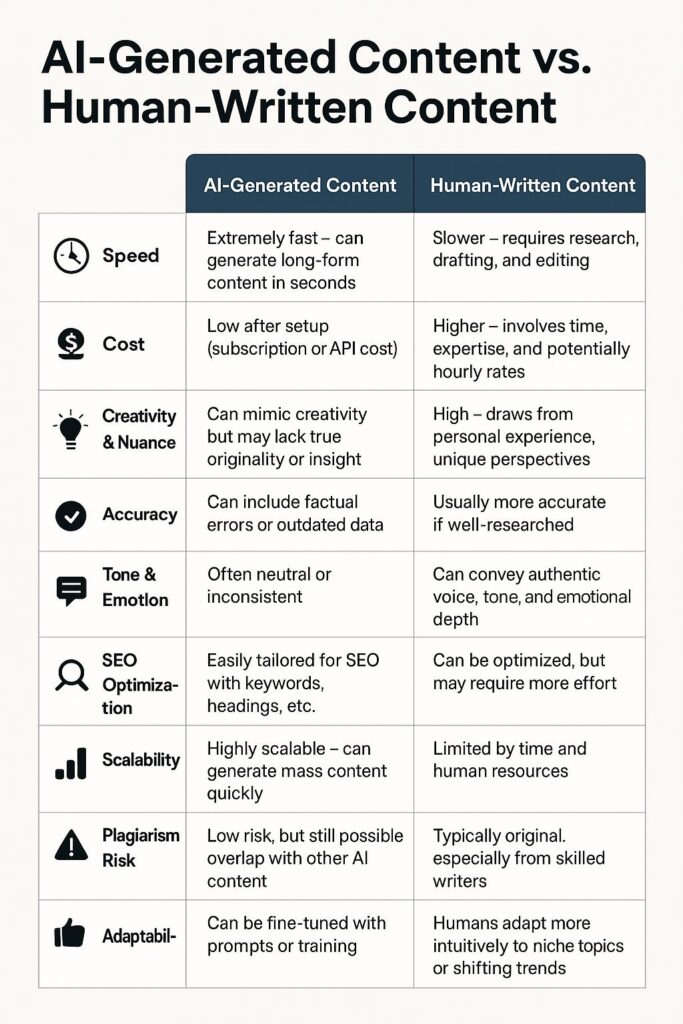
Difference Between AI Content and Human Writing
1. Speed of Content Creation
AI content is much faster compared to human writing. A complete article can be generated within minutes using AI tools.
Human writers usually spend hours researching, writing, editing, and optimizing content.
Winner:
AI Content
2. Creativity and Originality
AI tools generate content based on existing data patterns. While they can create decent content, they still struggle with deep creativity and unique storytelling.
Human writers can think emotionally, create original ideas, and connect better with readers.
Winner:
Human Writing
3. SEO Optimization
AI tools are excellent at generating SEO-friendly structures, keyword placements, headings, and meta descriptions. They help bloggers create optimized content quickly.
However, human writers understand user intent more effectively and can naturally integrate keywords without overstuffing.
Winner:
Tie Between Both
4. Emotional Connection
One major weakness of AI content is the lack of emotional depth. AI cannot truly understand feelings, experiences, or human emotions.
Human-written content creates trust and emotional engagement, which improves user experience and increases reader retention.
Winner:
Human Writing
5. Accuracy and Fact Checking
AI tools sometimes generate incorrect or outdated information because they rely on patterns rather than true understanding.
Human writers can verify facts, conduct deep research, and provide more reliable information.
Winner:
Human Writing
Does Google Allow AI Content?
Yes, Google allows AI-generated content.
Google has clearly stated that it focuses on the quality and usefulness of content rather than how the content is created. This means AI content can rank well if it provides value to users.
However, Google strongly discourages spammy, low-quality, and automatically generated content created only to manipulate rankings.
Google mainly evaluates content based on:
- Helpfulness
- Originality
- User Experience
- Expertise
- Trustworthiness
- Relevance
If your AI content is properly edited, fact-checked, and useful for readers, it can rank successfully.
What is Google’s EEAT Principle?
Google uses EEAT to evaluate content quality.
EEAT stands for:
- Experience
- Expertise
- Authoritativeness
- Trustworthiness
Human-written content usually performs better in EEAT because it includes personal experience, professional insights, and authentic opinions.
For example, a medical article written by an experienced doctor is more trustworthy than an AI-generated article without expertise.
This is why businesses and bloggers should focus on combining AI efficiency with human experience.
Benefits of AI Content for SEO
1. Faster Content Production
AI tools help bloggers publish content consistently. This improves website freshness and increases indexing opportunities.
2. Better Keyword Optimization
AI writing tools can naturally place focus keywords throughout the article, improving on-page SEO.
3. Content Ideas and Research
AI tools help generate blog ideas, FAQs, headings, and outlines quickly.
4. Cost Effective
Hiring professional writers can be expensive. AI tools reduce content production costs significantly.
5. Multilingual Content Creation
AI tools can generate content in multiple languages, helping businesses target global audiences.
Disadvantages of AI Content
1. Lack of Human Experience
AI cannot share personal stories or real-world experiences.
2. Repetitive Writing Style
Many AI-generated articles sound robotic or repetitive.
3. Risk of Inaccurate Information
AI sometimes creates misleading or false information if prompts are unclear.
4. Weak Emotional Engagement
Readers connect more with human emotions and storytelling.
5. Lower Brand Identity
Pure AI content often lacks a unique brand voice.
Why Human Writing Still Matters for SEO
Even though AI tools are powerful, human writers still have major advantages.
Better Audience Understanding
Humans understand audience emotions, pain points, and psychology more deeply.
Stronger Storytelling
Storytelling improves engagement and makes content memorable.
Higher Trust
Readers trust content written by real experts more than automated content.
Better Conversion Rates
Human-written copy usually converts better because it connects emotionally with users.
Can AI Content Rank on Google?
Yes, AI-generated content can rank if it is:
- Helpful
- Unique
- Well-optimized
- Fact-checked
- Edited by humans
Many websites already use AI-assisted content successfully. However, websites that publish low-quality AI spam may face ranking drops.
The key is not whether content is AI or human-written.
The key is quality.
Best SEO Strategy in 2026
The best strategy is combining AI with human editing.
Instead of fully depending on AI, bloggers should use AI as a writing assistant.
Use AI For:
- Generating outlines
- Keyword ideas
- Draft writing
- Meta descriptions
- FAQ generation
Use Humans For:
- Editing
- Fact checking
- Storytelling
- Adding expertise
- Improving readability
- Emotional connection
This hybrid strategy saves time while maintaining high content quality.
Future of AI Content in SEO
AI will continue to grow in digital marketing and SEO. However, Google will become even smarter at identifying low-quality content.
Websites that focus only on mass-producing AI articles without quality improvements may struggle in future rankings.
The future belongs to creators who combine:
- AI efficiency
- Human creativity
- Real expertise
- User-focused content
Businesses that balance both will achieve the best SEO results.
Final Verdict: What Does Google Prefer?
Google does not specifically prefer AI content or human writing.
Google prefers high-quality, helpful, trustworthy, and user-focused content.
AI content is excellent for speed, productivity, and SEO optimization. Human writing is better for creativity, emotional connection, and trust building.
The best solution is combining both.
Use AI to improve productivity and humans to improve quality.
That is the smartest SEO strategy for 2026.
FAQs
Is AI content bad for SEO?
No, AI content is not bad for SEO if it is helpful, original, and properly edited.
Can Google detect AI-generated content?
Google can identify low-quality spam content, but it mainly focuses on usefulness rather than the writing method.
Which is better for blogging: AI or human writing?
Human writing is better for trust and creativity, while AI helps with speed and efficiency.
Should bloggers use AI tools?
Yes, AI tools can improve productivity when combined with human editing and expertise.
Will AI replace content writers?
AI may automate basic writing tasks, but skilled human writers will still be valuable for creativity, strategy, and emotional storytelling.